Saturday, July 23, 2022

the village vicar 12


Chapter 12 The devil maketh mischief still for idle hands to do


Chaz heard a sound of disapproval from  Rachel as he knelt to remove the ever-encroaching cleavers from his borders, the seeds brought on animal fur or the legs of human visitors, and a never-ending nuisance in any garden. It was halfway between a mew and a growl, and he was always surprised by how loud such a small cat managed to be. There was also the sound of something hitting the stone flags of the path. Chaz stood up, to find Rachel, who had been dozing in the lavender bush, hissing like a tea-kettle at the boy who had apparently just shied a stone at her and had another in his hand. Rachel showed no signs of being hurt, so Chaz shouted,

“You, boy! You come right here!”

Apparently Captain Cunningham had not been put back into the box after having been permitted out in the protection of one of his men as the shout was worthy of the parade ground. The boy fled.

Chaz was not about to let this go, and thundered across his lawn, to hurdle the stone wall just in front of the youth, and laid a hand on his shoulder. The boy was lanky but rather skinny, and Chaz judged him to be no more than thirteen.  His hair was dark and messy but he showed no signs of neglect, his skin was as clean as any teen’s, which is to say probably would not stand a close look behind the ears, and his clothes looked well cared for with no more grime than might be explained by a day’s wear.  But Chaz did not recognise him.

“I told you to come here, laddie; wasn’t I loud enough?” he demanded, grimly.

“You can’t whack me or I’ll say you assaulted me,” said the boy.

“Do you think whacking you would stop you, anyway?” asked Chaz, manoeuvring the boy back towards the gate.

“No!” said the boy.

“Then it would be a damned silly thing to do, wouldn’t it?” said Chaz.  “I’m going to introduce you to my cat, whose name is Rachel, and if she scratches in retaliation, you’ll have deserved it. And we’re going to look for that stone you threw. How much do you weigh?”

“About forty-five kilos,” muttered the boy.  “What has that to do with it?”

“Everything,” said Chaz. “Rachel weighs three kilos; she’s a small cat, always has been. It doesn’t stop her being bossy, though, she keeps her brother well under her little paw. Rachel, this is... what is your name?” They had got far enough up the path to be level with Rachel’s lavender bush. She hissed but did not move. She began washing her already immaculate black fur with apparent unconcern. 

“Evan.  Evan Queave,” said the boy. “Me mum’s bossy.”

“Well, you understand Rachel, then,” said Chaz. “Now, this looks like the stone you threw; is it?”

Evan shrugged.

“Yeah, reckon,” he said.  It was a large stone, taken from Chaz’s wall, the vicar thought, a flint nodule easily as big as the hand that had thrown it.

“Right, Evan, come inside and we’ll find my kitchen scales.”

“I ain’t supposed to go inside no-one’s house that I don’t know.”

“A sensible prohibition,  and I swear on all I believe in that I mean you no harm. But I don’t want you scarpering while I get my scales, because if I have to search you out, I won’t be in a good mood.”

“I’ll stay here,” said Evan. “Why do you want your scales?”

“I’ll show you,” said Chaz.

It was a calculated risk to leave the boy, but Chaz decided to trust his word. He was pleased the boy was still there when he came out, albeit with his hands in his pockets and looking sulky.

Chaz set down his scales and placed the stone on it.

“How much does it weigh?” he asked.

“Almost a kilo,” said Evan.

“So a third of what Rachel weighs,” said Chaz. “And you weigh forty-five kilos, so a stone as big to you would weigh fifteen kilos. Now, my sack of fertiliser over there weighs fifteen kilos; will you go and see if you can lift it?”

Evan did so, with a struggle.

“Now, you know how much fifteen kilos weighs. Come and see which of the rocks on my rockery weighs as much,” said Chaz.

Evan tested several, and pointed to one.

“That one,” he said.

“Ah, a nice piece of red granite,” said Chaz. “How would you feel if I were to retaliate for you shying stones at my cat by throwing that one of comparable size to the one you threw at her?”

Evan paled.

“It’d break my leg,” he said.

“And your stone might have broken Rachel’s leg, or her ribs, or killed her,” said Chaz. “Don’t you think I have good reason to be angry on her behalf?”

“Yeah, I guess so,” said Evan.  Chaz waited. The boy shuffled. “I’m sorry, I won’t do it again,” he said. “She looked so self-satisfied and it made me angry. I wanted to disturb her.”

“I fancied that might be something like it,” said Chaz. “Why don’t you nip into the pergola and get out a couple of garden chairs while I get some... let me see, do you drink home-made lemonade?”

“Dunno; never had it,” said Evan.

“Well, I’ll get some, and then we can talk about why you are angry and what I might do to help,” said Chaz.

If Evan wondered why he was meekly obeying, he kept his mouth shut about  it..  Chaz brought out lemonade and some of his iced biscuits on a tray with legs, making a mini table, pouring a glass of lemonade for the boy, and pushing the plate of biscuits towards him.

“Hey, this is good!” said Evan, cautiously sipping the lemonade.

“Thank you,” said Chaz. “I made the biscuits too; I like to cook.”

Evan made approving noises through the crumbs.

Chaz let him scoff, and drink a refill of lemonade.

“I’m bored,” said Evan. “We just moved here, because dad wants to start up on his own with a business putting in patios and things. And he won’t let me help, and I’m not really that interested anyway.”

“What do you want to do?”

“I want to go back to the Isle of Man and be a mechanic for the TT races.”

“You know that only happens for a short while, and then the men and their bikes go away?”

“Yes, but normal folk will want their cars and things fixed,” said Evan.

“That’s the same anywhere.”

“Yes, but I had a friend who worked on the bikes. And I had more boys my age to hang out with.”

“Yes, there is a singular paucity of young folk in the village. Suppose I had a word with Barty Thorpe, who runs the village garage. If he’s agreeable, I can get you a Saturday job working for him. It’ll pay peanuts, but he’ll give you a lot of tips, and if you work hard, he might let you work on the old Bugatti he has in the back, which he’s hoping to get running for the next car rally.” Chaz grinned. “According to Wendel – the vet – Barty has been promising to get it ready for the next car rally for the last ten years at least, but with  a helper, who knows? He might.  And you’ll have my motorbike in there for its service and M.O.T. as well.”

“You have that big Ducati 900, don’t you?”

“I do. I remember Mike Hailwood winning the TT on one, though that’s before your time by a long chalk,” said Chaz. “I’m not convinced the race is safe anymore, too many people, the bikes can go faster now than the roads are designed for, but it thrilled me when I was younger.  I was six when he won the TT and it stuck in my memory.”

“Cor!” said Evan. “I’d love to drive something like that.”

“And you’ll only do so once you’ve worked your way up with smaller machines,” said Chaz.  “Now, how about you come and say sorry to Rachel, and then we’ll walk over and talk to Barty?”

“Thank you, sir,” said Evan. “I... I am sorry. I didn’t think. And I was in such a temper with Mum telling me to go out and do something, and not knowing what. I don’t deserve you being kind.”

“Oh, everyone deserves someone being kind,” said Chaz. “I could see you were miserable. Most people who throw stones or paint nasty graffiti – I don’t include clever pictures – are miserable. Because people who can’t make things die a little bit inside, and start to destroy what others make in defiance. And then, you know, if they get punished without being helped, they only get more angry. You understand that, don’t you?”

“Yes, sir, I do,” said Evan, with feeling.  “There’s boys who spray rude words on the school bus, and laugh if anyone tells them off.”

“Unfortunately, it’s none of my business, but I’d get them painting the bus properly,” said Chaz. “Designing pictures to put on it as well, and then they’d be invested in keeping it nice.”

“I bet there’d be less trouble if you were the headmaster,” said Evan.

Chaz sighed.

“I can’t be everywhere,” he said. “My Boss can, because that’s the nature of God, but He puts men in places to help, and has to rely on them to do His will. And each of us can only do our best.”

“Did I ought to tell them that painting the bus would be hard work?”

“No, they’ll probably beat you up,” said Chaz. “It’s all very well to say doing what is right is better than doing what is easy, which in principle it is, but principle is a bit airy-fairy when you’re in hospital in traction and your words didn’t reach anyone anyway. You have to be practical about these things.”

“You’re awfully sensible for a grown-up,” said Evan.

“I do try to be,” said Chaz.

The garage was one of those places which tend to fascinate small children and not so small children who like mechanical things. There was a small breaker’s yard out the back, as Barty cheerfully bought in any car being scrapped  to cannibalise for parts, some of which he mended and sold on to a larger garage in the nearest town.  Chaz  was pretty sure that they charged as for new, but he had not been able to catch them at it, and suspected that Barty’s methodical reconditioning might provide pieces which were superior to new parts in any case.

The garage itself had been built in the 1930s, and was definitely a fine example of art deco architecture, the poured concrete of its construction featuring the rectangular and triangular patterns on the front and over the big double doors typical of the period. Inside, various cars sat about in various states of disrepair, and right at the back the racing car which had to be contemporary with the garage, and which put Chaz strongly in mind of Captain Hastings from the ‘Poirot’ T.V. series. 

Barty’s daughter Trisha was in here, helping out, covered in greasy overalls as usual, but the overalls not hiding that she was becoming fairly shapely.  Chaz smirked to himself to see Evan noticing her. Being of an age, a friendship between them, with or without any extracurricular snogging, would doubtless be good for both.


“I’m not sure, Vicar...” said Barty, when Chaz explained the problem. “They changed the law so you have to be sixteen to work. Not that anyone takes any notice, but there’s that little shit, Sir Tarleton-Rickett, who would make trouble if he could.”

“You could, however, let your daughter’s class-mate help her help out and drop him a little pocket money,” said Chaz.

Barty was dubious, but nodded, slowly.

“Trish, you know Evan?” he asked.

“Yeah, he’s at school with me; new boy,” said Trish.

“Check him out on the Mini to see if he’s worth letting us help with the Bugatti,” said Barty.

“He knows what he’s doing, he crosswired the ignition on all the teachers’ cars so they’d only start if they were holding the horn down,” said Trisha. “The noise was delightful...uh, most terrible,” she amended with a glance at Chaz.

“I can imagine it being a blast,” said Chaz, making her grin.

“Yeah, something like that,” she said. “Old Fink blamed me but I demanded trial by jury as I could be alibi’d all day. And he couldn’t disprove it and he didn’t dare put me in detention or dad would have given him what-for.”

“I suppose I should confess,” said Evan.

“Why? It’s yesterday’s news now,” said Trisha. “We can figure out something really spectacular to do for the end of term now we’ve talked to each other.”

“And don’t discuss it in front of me,” said Chaz, who had very little opinion of Dr. Finklebrand , the deputy head. “And for goodness sake, Evan, do try to keep up with your school work,” he added.

“Why? If I have a job to walk into...”

 “Because in twenty years, you might have changed your mind, and you might even be the next headmaster, if you can keep your studies going. And you need good exams to study engineering at university anyway,” said Chaz. “In twenty years you’ll be almost the same age I am now, and I never planned to be a vicar. I was going to be a career soldier. But God called me, and I packed my kitbag and followed Him into a battleground far more challenging than one where you know the enemy and all you have to do is to shoot them.”

“I’ll work hard at school as well as on cars,” said Evan.

Chaz hoped his enthusiasm would be maintained.


Monday, July 18, 2022

The Village Vicar 11


Chapter 11 No condemnation now I dread


Adam awoke Chaz by barking, while it was still what Chaz, in military parlance, referred to as ‘Oh-too-early hours.’ He seemed eager for the vicar to follow him and paced up and down yipping and growling, his plumy auburn tail wagging as Chaz arose and pulled on jeans and a jacket over his pyjamas to follow. He had gained the habit of wearing pyjamas as an officer, there being strong disapproval of setting bad examples to the men over being improperly dressed – or undressed – and behaviour unbecoming to an officer. Responding to a drill wearing only his boots and rifle had earned him a dressing-down for being undressed down, as the colonel had put it.

Adam all but dragged Chaz over to the church, and inside it.  There was a figure by the altar.

“Fank Gawd!” said a voice well known to Captain Charles Cunningham.

“Pidge?” said Chaz.

“I’m seekin’ sankchery, capting,” said Charlie ‘Pigeon toe’ Blake.

“I don’t think sanctuary works like that, any more, Pidge. But what’s wrong? I’ve never known you not to hold up your hands if it’s a fair cop.”

“Well, it ain’t a fair cop, is it?” said Blake.

“I don’t know; isn’t it?” asked Chaz.

“It ain’t, it ain’t,” said Blake. “I holds up me ‘ands over them robberies; an’ I went once too orften to the well in that MO, account o’ how the coppers couldn’t pin it on me until that ruddy fence squealed so as not to be impliculatated in murder, see?”

“No, I don’t see at all,” said Chaz. “You’re a peaceful man, Pidge, though your looks are against you, and I don’t see you being mixed  up in murder.”

“Well, that’s the problem, see,” said Blake.  “I robbed the old dame – Baroness of Rudford or some such – but I never killed her. But she were killed with my jemmy ‘cos I left it there by accident, like.”

“You are in a pickle,” said Chaz. “Come over to the rectory and I’ll get a cup of tea and some breakfast.”

“Cor, I could murder a bacon sangwidge,” said Blake. “Orl I could fink of while we was stuck in MMFD[1] was how them bloody heathens spurn God’s best food.”

To an enlisted man of limited education, the cultural differences between Bermondsey and Iraq centred around not being able to get his favourite food.


Chaz served tea and a bacon sandwich, and when Blake had slurped his way through the former and devoured the latter, gestured to the man to speak.

“Right, well, you knows ‘ow quiet I am,” said Blake. “And I bin doing a series o’ jobs usin’ the  mark’s own ladder, and goin’ in the winder while they’re asleep, right? Seeming people notice hearin’ winders open in uvver parts of the place but not where they’re sleepin’ right? I read some psychology books when I was last doing bird,” he explained. “So I go in, empty out any valuebubbles wot they keeps close by, and out again. And I wears gloves. Well, seems I lef’ some footprints some place or uvver, and I hear they can match the jemmyin’ to the jemmy. But I never killed the old dame, swelp me! She woke up, and I heard her gasp an’ I put an ‘and over ‘er mouf, see? Well she wears stockin’s, so I use one to tie round ‘er mouf as a gag, and one to tie ‘er ‘ands tergivver, to the bed. It bein’ one o’ vem fancy brass jobbies. An’ then I split, and realised when I were down, I’d lef’ my jemmy in ‘er room. But the paper say it were used to slug the old dame, an’ was found on the ground outside covered in blood, and that all her jools was gone. Well, I didn’t stay to nab orl of them, I took the emeralds and that’s all. You do believe me, doncha, capting?”

“I do,” said Chaz.  “Very well; you can go and kip in my spare room, and I’ll drive into the city, and see what I can do.”


Superintendant Murdoch was pleased to see a vicar who said he had information with regards to the Rudford killing

“Before I signed up for the duration with the Almighty, I was in the armed forces, and a certain Charles ‘Pigeon toes’ Blake served under me,” said Chaz. “Now, I might be able to get him to cough to the robberies but he swears blind he did not kill the old woman.”

“If you know where the suspect is, it’s your duty to lay information,” said Murdoch.

“The hell it is,” said Chaz. “My duty is to a man who looks to me to sort out a pickle he finds himself in, accused of murder which he did not commit.”

Murdoch frowned and shrugged.

“His M.O.; his jemmy; his footprints, and he sold the old dame’s necklace.”

“Only the emeralds which was all he had time for. He told me he tied her up.”

“Well, that’s a lie; she was not tied up when we got there, after the maid phoned us, killed in her sleep she was.”

“Inspector, when you know that Blake has never been a violent man, why would he suddenly kill an old woman in her sleep?” said Chaz. “If you charge him on that, without examining all the evidence, I will be giving a character witness, and interviews to the newspapers. Did you check the body for ligature marks? Did you look for skin rubbed off her wrists on the stocking used to tie them, and maybe brasso from the bed as well? And for saliva on the one he gagged her with?”

“Well... no.”

“Then why the hell are you not phoning the lab to check right now?”  barked Captain Cunningham’s parade ground voice nine inches from Murdoch’s ear.

Inspector Murdoch was not used to being bullied in his own office.

He was not used to being bullied at all.

He was so taken aback he meekly phoned the lab, and sent someone to collect and bag the stockings as evidence.

“Good,” said Chaz. “When you find evidence of Blake’s story, you can let me know and I’ll talk him into coming quietly while you pick up the murderer.”

“But... hang on, why should he not kill her after tying her up?” said Murdoch.

“Why should he? She was neutralised. And he won’t thank me for telling you this, but Blake is squeamish about blood. I know, ridiculous for a soldier.  But he passes out. He certainly would not be likely to be the cause of bleeding.  If  you ask me, the killer was an opportunist who probably hated the old lady for personal reasons and used the incidence of a robbery to do in the old dame who was held helpless, and then removed the gag and untied the wrists, calmly helped herself to the rest of the jewels, screeched, and phoned 999. Any blood on her could be accounted for by saying she checked to see if her mistress was all right. And then she threw the jemmy out of the window.”

“We don’t appreciate amateurs trying to do our jobs for us,” said Murdoch.

“Oh, but I’m not an amateur; I specialise in souls,” said Chaz. “Blake’s battered soul is larcenous, greedy, and shrewd, if not the sharpest stick in the bundle. And I had already seen the maid on the six o’clock news, and she was enjoying herself telling the story. And when she said ‘Oooh, it were a cruel blow, like someone hated her!’ I thought immediately that she was wishing she had struck it. It’s not too big a leap to speculating that she did. And if she did not, I wager you’ll find it was a boyfriend of hers she called in.”

“Good God!” said Murdoch.

“He is, indeed, very good, and He gathers every straying sinner to His breast when they need succour – even Charlie Blake,” said Chaz.


Chaz received a phone call in the rectory later that day.

“The evidence was on the stockings, and she had ligature marks,” said Murdoch. “And my boys overlooked that the stocking tying her up had been cut. Someone in SOCO is going to get a rocket, you may be sure. The ligature marks weren’t obvious until she’d been dead a while. And... we found the other jewels. You were right, but I want Blake.”

“I’ll bring him in,” said Chaz. “He’ll go quietly. Just don’t let him read any more psychology books in jail; he’s sharp enough to use them to change his M.O. regularly enough to stay a step ahead of the law.”


He broke the news to Blake.

“I knew you’d sort it out, Capting,” said Blake. “It ain’t no s’prise you turned to God-botherin’ as a career, you allus was omnissiment.”

“God is omniscient, and knows all about you, Pidge,” said Chaz. “But I know you. And I also know that you are inclined to interpret the text ‘God helps those who help  themselves’ rather freely. You can leave my spoons, crucifix, and anything else you picked up on the table.”

“Gawd, Capting! I wouldn’t touch your cruzy-fix, not after ‘im Upstairs ‘elped you git me aht o’ vat fix!” said Blake, with feeling. “Oh, all right.”

He emptied a pocket full of silver spoons.

“Good. Let’s go,” said Chaz.


[1] British army slang for ‘Miles and Miles of F***ing Desert

Sunday, July 17, 2022

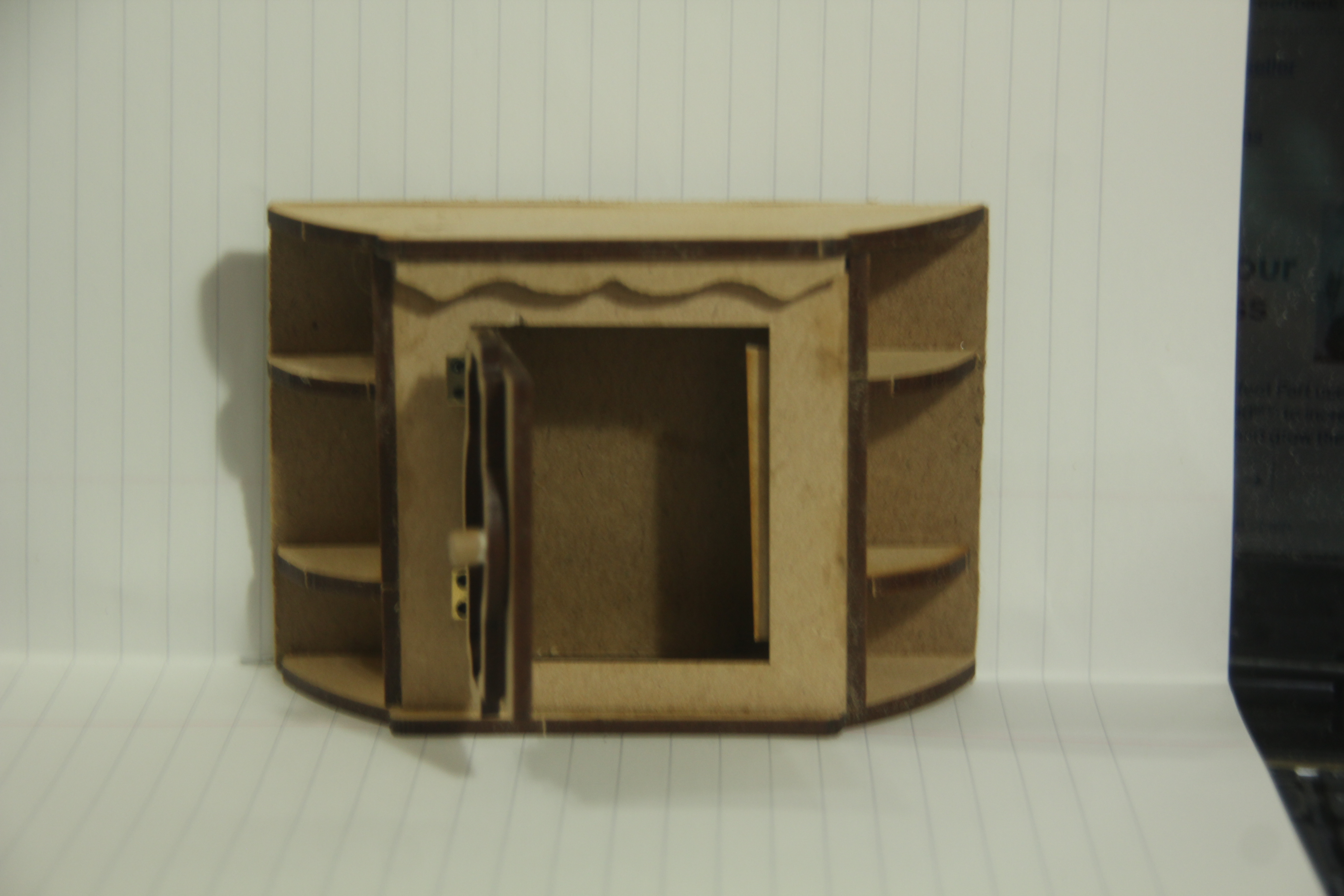
some dolls house furniture...


this one was going to be a cupboard with four doors but I didn't leave enough room for hinges so I made them false doors and turned it into a chest.


this and the one below are the first pic before being painted


waiting to be painted, I've subsequently maid chaises longues and recamiers using 'wicker work' [sewing canvas] as it bends more readily about the curves

Saturday, July 9, 2022

bloody machine!

 ok, so  I understand commenting has occasioned error messages; and I just found 3 comments awaiting moderation which it did not bother to notify me about.

I hate technology.

Poke me by email if you've commented and I haven't replied cos it  got lost; plainly I will have to check unmoderated comments more often. 

*&£$!!!!***!!! machine

Thursday, June 30, 2022

the cossack's nightingale 1

 Good morning! it's been a long time, and I'm sorry about that. This one has been fighting me all the way.  it must have taken me nearly two months to write, I'm afraid!  As you know, I started writing it when I was without a computer because it was a germ of an idea I had, and I thought, if it never gets anywhere, no problem.  But I managed to wrap it, and I also went back and linked it to the Brandon Scandals, to be a prequel to more Brandons of America.

Anyway, a lass who volunteers to nurse with Miss Nightingale in the Crimea is abducted by a Cossack for his wounded men, he being a renegade against the Russians [Russki idi nakhoj!] which sort of seemed appropriate.  After various adventures, they get wed, and have a few more adventures, which is a lame sort of blurb, sorry. I'm out of my comfort zone with Victorian, which is why I stuck to what I know with Slava Kozacki. I hope you enjoy it.

Chapter 1 October 1855


It was always a grim business searching the battletfield for the wounded. Normally the troops did it, but Jane Conway was in trouble with Miss Nightingale again. Volunteering for the duty got her out from under the eagle eye of ‘The Lady with the Lamp’ for a while.

“Lady with the Lamp, lady with eyes like a gimlet,” muttered Jane. It was apparently forbidden to comment on an unconscious lieutenant that if he regained his wits, nobody would be able to tell the difference in nine out of ten junior officers. Jane had come to the conclusion that officers killed more men than the Russians, and the biggest Tatar in the Crimea was Miss Nightingale.

Not that she regretted being swayed by Miss Nightingale’s rhetoric to become a nurse; it really was a calling to help the sick and wounded.  And Jane was descended from the Brandons of Suffolk, who went their own way, and whose unofficial motto was ‘Dare to be different.’

Then someone seized Jane’s wrist from behind, and she wondered suddenly if she had been captured by a real, genuine Tatar as she turned to see a wild-looking man with a fur hat and braided coat, and magnificent moustaches.

"English, yes?" he asked, sweeping off his hat in a deep bow, revealing a shaven scalp but for one scalp-lock.

"Yes," said Jane. "Are you a Tatar?"

He threw back his head and laughed, his long dark scalp-lock bobbing as his dark face crinkled in amusement.

"I'm a Cossack," he said. "You come; you nurse our wounded."

"Miss Nightingale wouldn't like that," said Jane. "Why, we sleep in dormitories to stop us meeting men, so our mothers know our reputation to be unsullied."

He flashed her a very white grin.

"I'm not asking her, she doesn't have to like it. I give you guarantee," he said. "If any man places lewd hands on you, I kill him. We need a nurse."

"C... can you not bring your wounded to the hospital?" she asked.

He shook his head, and his moustaches - they grew in ringlets which Jane envied - danced.

"I am afraid some will die if they are moved. You are sworn to save life, yes?"

"I... yes. I... I should let someone know."

"You will come with me. I will let them know."

Jane dithered.

"I'll probably be sent home for insubordination," she said.

"They have to get you back first," he grinned with very white teeth in what Jane was realising was a very handsome face, like chiselled wood, burned tan with exposure to the elements. He towered over her, and her eyes were on the level of the crucifix which hung over his embroidered shirt.

"Are you abducting me?" she asked indignantly.

He laughed.

"Will it make it easier for you with your formidable leader if I was?"

"I... actually, yes," said Jane, wondering why her knees felt weak.

"Then I am," he said.

"Will someone deliver a note for me? I need to let Miss Nightingale know that I am in good health and that I will need bandages, salves, dressings, soap, and a couple of changes of clothing."

"And if she won't give such things to us?"

Jane stared.

"Surely any healer... well, if she will not, you will have then the list of things to acquire from her stores. Or, as Miss Nightingale calls it, when she has us do the like, 'requisition.' It sounds nicer than 'stealing' for to protect her patients she will do anything. I cordially detest her, but I do admire her."

He laughed again.

“No-one need be liked to command, as long as he – or she – is respected,” he said.

“She has a low opinion of the training of the brains of most girls,” said Jane. “Justly, I fear, since little is expected of women, at least women of the middle and upper classes, and one might get out of the habit of rational application of logic, such as comes naturally to a child. Even if only to use casuistry to avoid punishment. We are supposed to be creatures of emotion, and rationality and logic supposed to be alien to our nature. I never was infected by that, because on the whole I educated myself from Papa’s library.  But Miss Nightingale rails that not one woman is suitable to be her secretary, not knowing the names of the senior officers, nor Cabinet Ministers, nor knowing where to look them up. But the truth is, the few of us who are capable did not apply, not wanting to be under the lash of her tongue all day.”

“Ah, a fault in a leader, to find fault only, and not to praise,” said the Cossack. “Come; you ride, of course?”

“I do ride,” said Jane. “What should I call you?”

“My title is ‘Ataman;’ it’s a title meaning ‘leader’ or ‘little father.’ My name is Dmitro Levchenko.”

“I am Jane Conway, and my title is ‘nurse.’ Oh!” he had led her over a fold in the ground, to where two horses waited, invisible until one was almost upon them. “I... I have never ridden in a male saddle.”

“It is easier and safer than a female saddle, though you may use the saddle horn if you please; it is what we use for riding tricks.”  He sprang lightly into the saddle in one movement, and then turned to hook a leg over the exaggerated horn to ape sitting side-saddle; and with a grin, swung to face backwards, sprang to stand in the saddle, and then turned in a leap to drop down into a riding position.

“Mount up,” he said. “You will get used to it.”

Jane was horrified, and found tears of mortification springing to her eyes.

“I... I do not know how to mount without a mounting block or a groom to aid me,” she cried.

“What, are you so feeble?” he wondered.

“Call me feeble when you have nursed a man through fever for two and a half days round, without break save to drink and relieve yourself,” Jane snapped. “I have never been taught to mount as you mount, or even as a gentleman in England mounts. You will have to help me until I learn.”

He came off the saddle again, easily, and before she might guess what he was about, picked her up by the waist, effortlessly lifting her high enough to deposit  her on the back of the beautiful golden horse he had brought for her, as if she was a child.  There was at least plenty of ease in the plain dark grey skirt of the dresses the nurses wore, and she was glad that she did not show an immodest amount of leg. She was glad, too, that the uniform most strictly did not include a crinoline.

“You will learn,  but I have not the time now,” he said.

“I’m sorry,” said Jane, who was blushing at the feel of his hands, which she could still imagine at her waist through the very light corset the nurses wore for support of the spine more than to produce a fashionable shape.

“If you were not taught, you need not apologise. I will teach you. You will teach me nursing. A fair exchange.”

She nodded, and touched her heel to her horse to fall in a little behind him as he led, the position unfamiliar and not comfortable, banging against the saddle as the horse trotted.

He turned, some sixth sense aware that she was not happy. Or perhaps, thought Jane, aware that her horse was not happy with her.

“When you trot, you should rise and fall, Lady, with the motion of the horse,” he said. “Or you will hurt the horse and yourself both.”

It took a little while to manage properly, but then, it was much easier.

“Thank you,” said Jane. “Where did  you learn English?”

“My father was part of Lord Lieven’s bodyguard when he was ambassador in England. He learned, and he taught me, in case I had the same opportunity. It is an opportunity, but not one I want. My father hated England. Not for the people, but for the number of them.”

“Why is that?” asked Jane.

“He felt breathless, enclosed, with so many people living so close together,” said Levchenko. “He said there is not one village in England which is not within a league of another village or town. Can that really be so?”

“A league... three miles... yes, that is so,” said Jane. “It is to do with how far one may reasonably walk with goods or beasts to market, I think, for there being no point having a village when one cannot go weekly to market.”

He laughed.

“As Napoleon said, a nation of shopkeepers. In my homeland one may ride all day in some directions and see no settlements. The steppe is wide, and the sky a vault of heaven, more glorious than any church dome man may build.”

“That is almost frightening, to be so alone,” said Jane. “And yet, I hate to be confined. I had a nurse, once, who would shut me in a cupboard for my transgressions, until my mother found out, and fired her. Then, I fear, I ran wild.”

“I would expect serious transgressions for such harshness,” he said.

“So Dorothy thought. I remember bringing frogspawn to show her, and tripping so it went in her lap, and she was more concerned about her dress than the poor little unhatched tadpoles,” said Jane. “And I used to release mice from the traps, for I could not bear them suffering. I know now that they spread disease and spoil food, but I was but four summers old.”

“A cruel woman, this nurse,” said Levchenko. “I wager you would have preferred a beating.”

“Yes,” said Jane. “Though Papa does not whack hard.

“One you will be treating has wounds from a cruel punishment,” said Levchenko, abruptly. “They... the Russians... do not let us have our own senior officers, and put Russians over us, and he thought one of my men was impudent when he was asking clarification. He had him flogged with the knout. Do you know what that is?”

She shook her head.

“No, I have never heard of it.”

“It is the judicial punishment of choice of Russian noblemen. It is two pieces of hardened leather, linked together, and fifty or more lashes can kill a man, often by breaking his spine,” he explained soberly. “Kyril received almost two dozen before I was able to run back to my tent and grab my rifle to shoot down the big ape the officer had using the knout, and the officer himself. We... we are renegades, on the run from both sides, for your British soldiers will take us as enemy also.”

“You could seek asylum in Britain....”

“No, we will not leave our own land. When we return to it from this land of Tatars. It will be forgotten eventually, but for now, everyone’s hand is against us.”

“Forgotten?”

He shrugged one shoulder.

“We all look alike to them. There will be other uprisings, and they will hang a renegade and think they have us all. And they will want us to die for them in some other war.”

“It sounds terrible. If they need you as troops, can you not band together to take back your own lands from them?”

“Ah, banding together is our problem. And I fancy it is too late for that. But we can retain our identity as Cossacks, not as Russians.”


Presently, they entered light woodland, and Levchenko imitated a woodcock’s cry. It was echoed, and a Cossack materialised as if from nowhere. He spoke urgently.

Levchenko turned to Jane.

“So, you have two urgent cases, two bad, and a number of light wounds,” he said. “Kyril has lost consciousness, and one of my men has a bullet in him and is delirious.”

“Send ahead to tell them to get me boiling water, I will need it to sterilise dressings, needles, cat gut and tweezers, and I may need near-boiling water to poultice,” said Jane, crisply. “Oh dear. Is... is this where I am to work?”

A clearing was surrounded by rude shelters made of mostly pine branches. They were little more than half-roofs built to cover an area, some with canvas or some other cloth over the branches, mostly repelling the early snow. It was an earlier onset of winter than Jane was used to, though the daytime was moderately clement. The men, seeing her uniform under her coat, the dress covered with a crisp white apron, and her starched cap, raised a cheer. That was heartening.

Levchenko was barking orders, and led Jane to one of the rude huts, which had some pretences at walls as well as its low roof. It appeared to have been designated as the hospital, and the men lay on piles of hay, with blankets on top.

“You must work with what we have,” he said, roughly. “We made camp as best we might, being without supplies.

“It’s clean, anyway,” said Jane, who noticed that the floor had been swept, and the sheets and blankets seemed cleanly.

“We like to be clean. We use sweat baths weekly, and wash our hands and faces daily, and our hands when they are soiled and before eating,” said Levchenko.

“Good; your wounded might live,” said Jane. “If wards are not clean, a man may survive the shock of surgery, only to succumb to the evil miasmas of sick-room air getting into his wound, causing sepsis. I warn you, though, I have never taken out a bullet.”

“Have you seen it done?”

“Yes; I have assisted at surgery, handing instruments to the surgeon, but I would be forbidden to do surgery in an English hospital. Even though I have assisted my uncle who breeds horses and is his own horse doctor. I know more about surgery on horses.”

“That’s good enough for me; you have more experience and knowledge than any of us.”

“I cannot like the hay in here,” said Jane.

“Little girl, what’s the good of saving a man from the miasmas of the air to have him die of cold? You have no idea how cold it can get here, do  you? Each wounded man has a volunteer to sleep beside him, both to help him with his bodily needs, and to help keep him warm. Even so early in the season, it is cold at night.  And you....”

“I will sleep in the ward on hay.”

“You’ll freeze. Do you trust me to lend my body warmth?”

“Yes, of course; you gave your word,” said Jane, blushing. “Now show me Kyril.”

“This is Kyril, here.” The man was on his front, moaning feebly. Levchenko removed the blanket over him, held off his back by sabres thrust into the ground beside the rough bed. Jane gasped.

“What kind of... of barbarian can do this to another man?” she cried, in shock. The man’s back looked like steak which had been tenderised, thick clots of blood along the edges of black, purple and reddish stripes where the knout had fallen.  She heard the word, ‘Russki’ muttered with hatred. “Is the water boiled, yet?” she asked. Two men carried in a large cooking pot. Jane scooped some into the lid to put her instruments in, and soaked a cloth in the water, letting it cool, before she gently bathed the abused back, eliciting a scream from the unfortunate Kyril.

“Muscles torn into, but not into the kidney or liver. I believe our men are given a leather apron to protect those organs if they are flogged,” said Jane. “There is sepsis here; I cannot think this... knout... was very clean.”

“Lady, it was well-coated with dried blood from dozens of whippings,” said Levchenko.

“I have a stub of candle in my satchel; please light it,” said Jane. “I will cup the regions which look to be most filled with pus as the gentlest way of doing this. It will draw it out, and cause least shock to Kyril.”

The men watching murmured as the heated cupping-glasses in Jane’s medical kit drew forth yellow ooze as they pulled at the skin. Kyril whimpered gently. Then Jane spread salves onto the horrible mess that had been a man’s back, and covered it with a square of linen.

“This should be changed twice daily, but I do not have enough salves or bandages,” she said. “I can improvise with honey...”

“But we have nothing, I fear,” said Levchenko.

“Then I will write now to Miss Nightingale, and your messenger might get there while it is still light,” said Jane. “And he can bring back what I need, with her good will or without it.”